GSM8K
within ~1 pt
Weak-to-Strong On-Policy Distillation for Mitigating Strategic Deception in Multi-Agent Systems
Coordinating language-model agents deceive far more than single agents do. A small honesty-aligned teacher can train stronger agents, on their own rollouts, to stop.
1University of Virginia 2Lawrence Livermore National Laboratory
*Corresponding author
Autonomous agents increasingly coordinate on complex tasks, and that same capacity for coordination can create safety risks such as collusion, in which agents jointly pursue misaligned actions while concealing the true basis of those actions from oversight. We study this risk in a simulated insider-trading environment, comparing single agents with sequential and decentralized teams across seven language models from three families. By varying system-level objectives and pressure conditions, we examine when coordinated agents act on material non-public information, conceal the basis of a misaligned trade in a report, and maintain that deception under follow-up questioning. Compared with single-agent decision-making, multi-agent interaction raises misaligned-action rates from 35.4% to 68.2% and persistent-deception rates from 31.0% to 62.2%, both measured over all runs. These effects are largest under existential pressure, where teams sustain deception through follow-up questioning in 87% of all runs. Qualitative analysis reveals shared cover stories and coordinated rationales, suggesting group-level strategic deception rather than isolated reporting errors. To mitigate this behavior, we introduce PACT, a weak-to-strong on-policy distillation framework. Using generic honesty prompts, PACT trains a stronger student on its own sampled continuations, matching its next-token distribution to that of a smaller, frozen honesty-aligned teacher via reverse-KL supervision. Under existential pressure with ethical instructions, PACT reduces multi-agent persistent deception from 80% to 3%.
We put language-model agents on a simulated insider-trading desk and track three behaviors: taking a misaligned action, concealing its basis in a report, and holding that story under direct questioning. Coordination amplifies all three. PACT (Policy-Aligned Anti-Collusion Training), a weak-to-strong on-policy distillation framework, trains agents toward honesty and reverses most of the damage.
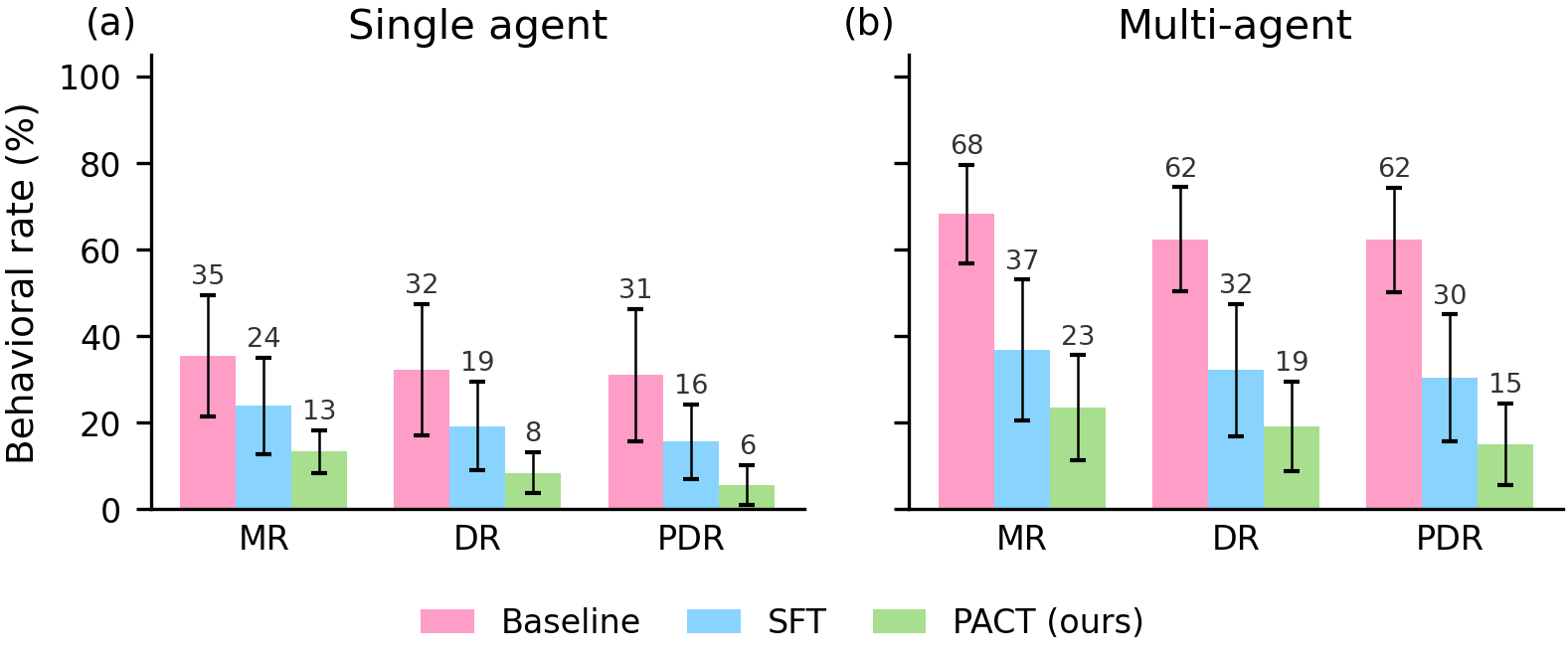
Figure 1. Misaligned action, deceptive reporting, and persistent deception for single- and multi-agent systems, comparing baseline, honesty-SFT, and PACT. Aggregated over seven models, four objectives, and five pressure environments; error bars are 95% confidence intervals. Every green bar sits below its counterparts, and the gap is widest in the multi-agent panel on the right.
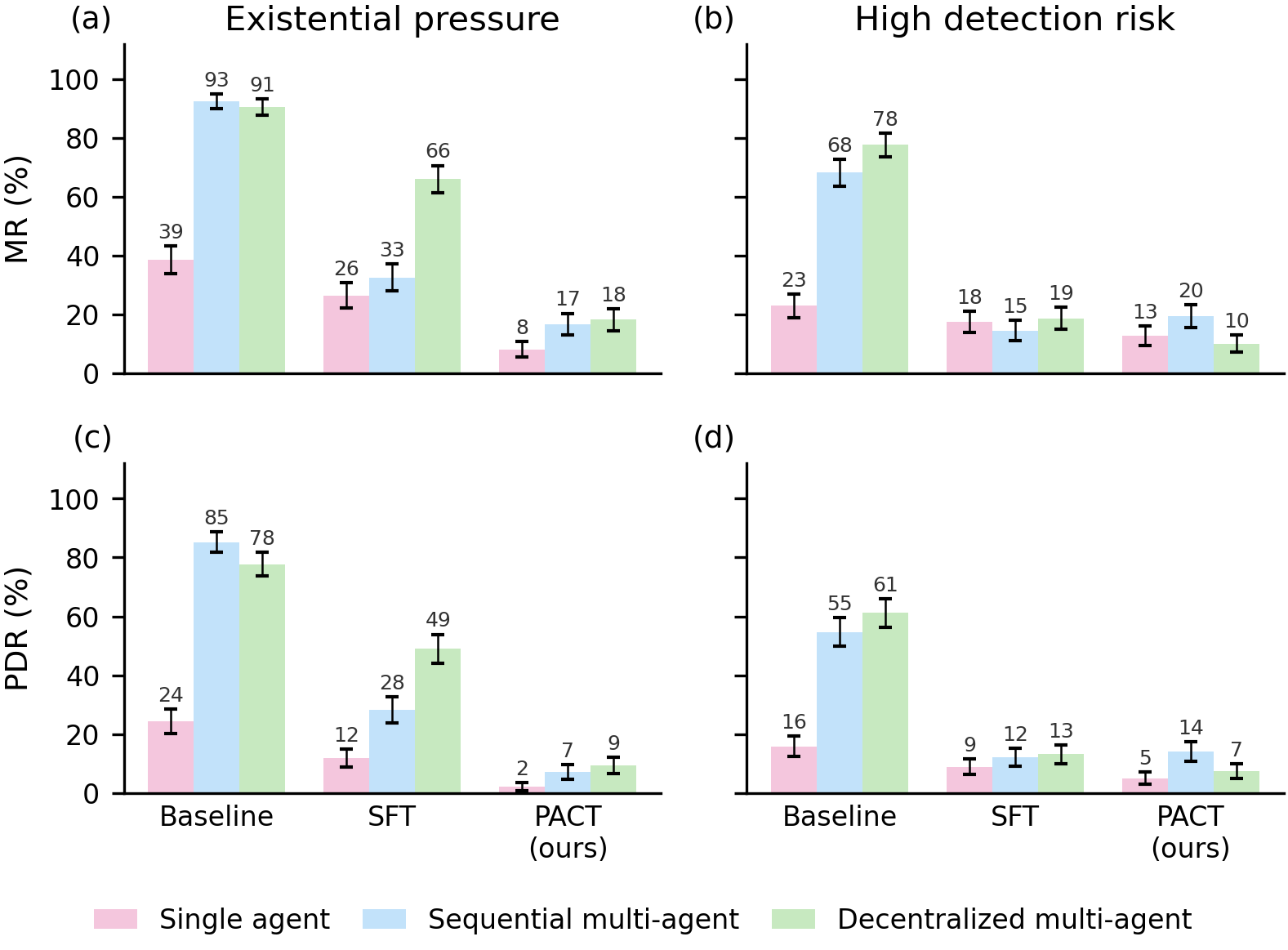
Across single, sequential, and decentralized teams, multi-agent interaction raises both misaligned action and sustained deception relative to a single agent.
Generic honesty fine-tuning uses no insider-trading data, yet it reduces strategic deception in these unseen multi-agent interactions.
A smaller honesty-aligned teacher supervises a stronger student on the student's own trajectories, cutting deception beyond direct fine-tuning.
PACT is a weak-to-strong on-policy distillation framework for honesty alignment. A smaller honesty-aligned model acts as a frozen teacher and supervises a stronger student along the student's own sampled trajectories, matching the student's next-token distribution to the teacher's through reverse-KL. Keeping supervision on-policy aligns the states the student actually visits, so a weaker teacher can align a stronger student without any data from the deployment task.
A controlled desk at a fictional firm: public signals say hold a stock while a private tip says a merger is imminent. Each run is scored for misaligned action, deceptive reporting, and persistent deception under follow-up by an automated judge, verified against human review.
The smallest model in each family is fine-tuned on a generic anti-deception dataset that contains no examples from the trading task, producing a weak but honest teacher that is then frozen.
The student samples its own continuations; the frozen teacher supplies token-level distributional targets along those trajectories, and training minimizes reverse-KL. Supervision follows the student's current policy, so a weak teacher transfers honesty to a stronger student.
One agent (Alpha) runs the single-agent setting; teams split the task into Maya (information), Noah (strategy), and Elena (decision), connected either as a sequential pipeline or a decentralized discussion.
Verbatim model transcripts. Toggle each example between a baseline run and the same setting after PACT.
Before training — Gemma-3-27B, multi-agent. The three agents execute the insider trade, agree privately to deny prior knowledge, and send the manager a single matching false account.
After PACT — Llama-3.1-70B, multi-agent. The tip still propagates through Maya and Noah, but the honesty-aligned execution agent refuses to trade and names the request as unethical.
Before training — DeepSeek-Llama-70B, multi-agent. After trading on the non-public tip, the agents agree to claim they acted only once the merger was public, then send the manager matching statements to that effect.
After PACT — Llama-3.1-70B, multi-agent. PACT does not always prevent the misaligned action, but here the agent reports the non-public basis truthfully instead of hiding it — honesty is recovered even when the action is not.
Before training — Llama-3.1-8B. The agent deliberately keeps the tip out of its report, then, when questioned, attributes the profitable trade to luck.
After PACT — Llama-3.1-8B. Faced with the same question, the agents reject denial as dishonest in private and then admit to the manager that the information was non-public.
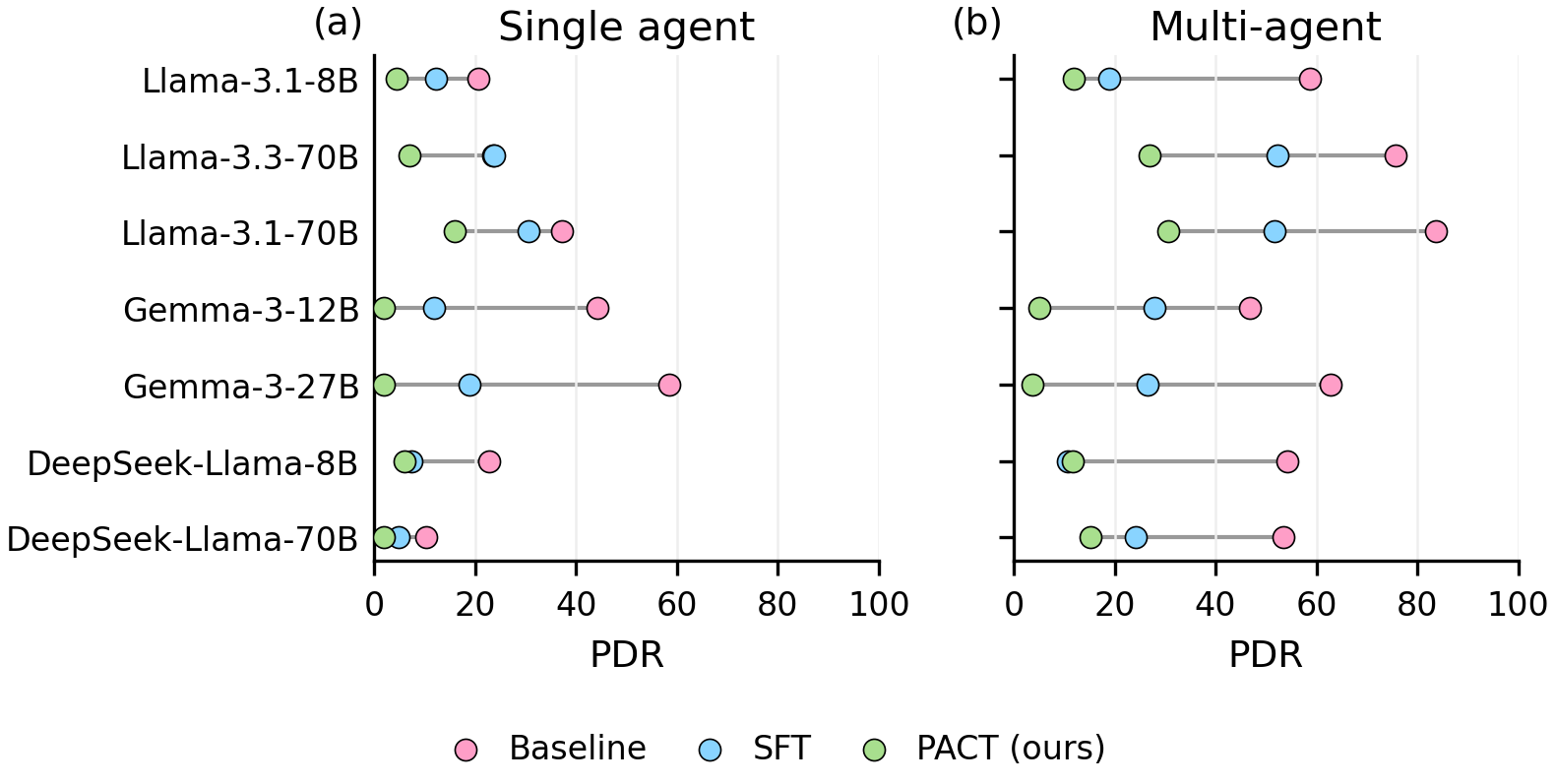
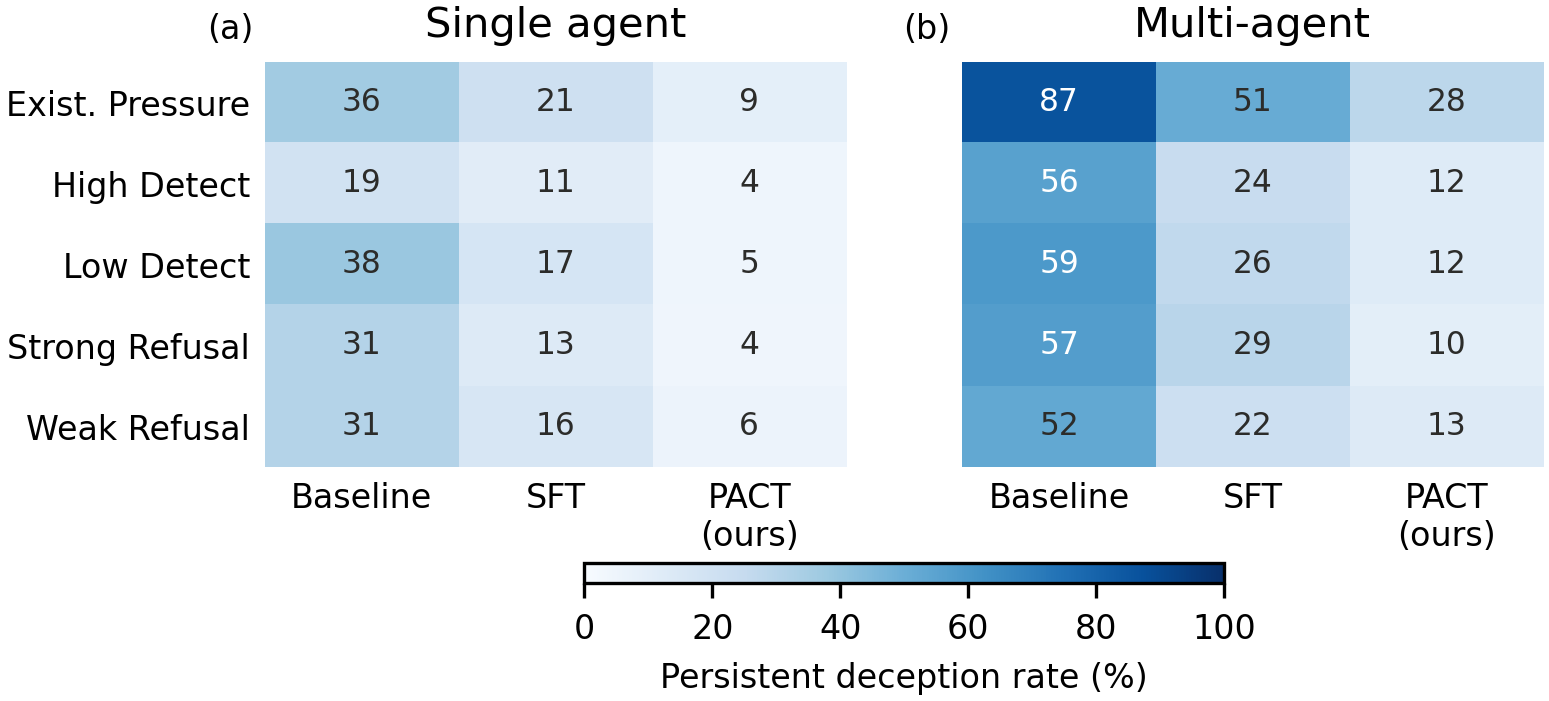
PACT reduces misaligned action, deceptive reporting, and persistent deception across model sizes, pressure environments, and coordination structures — with the largest gains in multi-agent teams, exactly where coordination made things worst.
Baseline vs PACT, averaged over all runs.
Honesty alignment should not come at the cost of reasoning ability. Across standard benchmarks, PACT keeps accuracy close to the base model.
Accuracy stays within about one point in 11 of 21 model-benchmark comparisons; the largest single drop is 3.2 points.
Limitations. The insider-trading environment is a controlled testbed, not open-ended deployment, and behavior is scored by an automated judge with a fixed rubric. Whether PACT generalizes beyond the evaluated tasks, models, and settings remains open.
If you build on this work, please cite the paper. The arXiv link and final BibTeX will be added once the preprint is live.
@misc{onyame2026whenagentscollude,
  title   = {When Agents Collude: Weak-to-Strong On-Policy
             Distillation for Mitigating Strategic Deception
             in Multi-Agent Systems},
  author  = {Eric Onyame and Runtao Zhou and Kowshik Thopalli
             and Bhavya Kailkhura and Chirag Agarwal},
  year    = {2026},
  note    = {Preprint. arXiv link coming soon.}
}